
Marine Drive Bridge UFO a Green Light Analysis

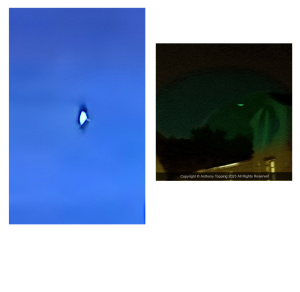
Marine Drive Bridge UFO a Green Light Analysis at Southport serves as a fascinating case study within the broader narrative of “Earth’s Glowing Ghosts,” atmospheric anomalies, and unexplained phenomena that have intrigued both researchers and the scientifically curious populace for decades. These occurrences, typically characterized by silent, hovering objects emitting steady monochromatic light—often in hues of green or blue—defy conventional aviation logic and evoke tantalizing questions about potential advanced propulsion systems or even undeclared natural plasma phenomena.
The Enigma of Southport’s Celestial Apparition
 The sighting of a silent, gliding object over the Marine Drive Bridge embodies traits reminiscent of the “Nocturnal Lights” category, meticulously defined by Dr. J. Allen Hynek, esteemed advisor to the U.S. Air Force’s Project Blue Book. They contrast starkly with traditional aircraft, which rely on Bernoulli’s principle to generate lift through forward momentum.
Particular intrigue surrounds the “green light” recorded during the Southport incident—a recurring motif woven throughout UFO literature. As articulated by Vincent Gaddis in his pivotal work, Mysterious Fires and Lights, such luminous displays frequently connect with high-energy electromagnetic fields capable of ionizing the surrounding atmosphere. The green illumination, notably at the 557.7 nm wavelength, aligns with the excitation of atomic oxygen—akin to phenomena observed in the Aurora Borealis—hinting at the generation of a powerful “plasma sheath” or an ion-driven propulsion system.
The Silent Hovercraft: A Theoretical Exploration
The near-complete absence of sound—perhaps the most striking detail of the Marine Drive Bridge encounter—raises profound questions about the propulsion methods of the observed phenomenon. Traditional methods of propulsion invariably involve air displacement and consequently create sound waves. In contrast, advanced theories regarding these “silent” vehicles often point towards Magnetohydrodynamics (MHD), a propulsion parallel in which the manipulation of ionized air using magnetic and electric fields may create thrust devoid of mechanical noise.
Moreover, the intelligence attributed to these lights—particularly their predilection for hovering over bridges or power lines—encourages speculation regarding the “Atmospheric Animal” or “Plasmoid” theory, as proposed by Ivan T. Sanderson, which posits that certain UFOs may not be mechanical constructs but rather “low-density, high-energy life forms” soaring amidst the heights of our atmosphere.

The Proxima Centauri Connection: A Galactic Dialogue
The red dwarf star Proxima Centauri and its hypothetical orbiting planets present an alluring backdrop for contextualizing communication with extraterrestrial factions. For beings on planets orbiting red dwarfs, the visual spectrum shifts towards the infrared, rendering a bright green light conspicuous and energetically significant. The utilization of green as a communicative signal may represent a “universal constant,” designed to penetrate Earth’s atmosphere with minimal interference and here is where the green light on the craft is of fascination. From an extraterrestrial perspective, the strategic use of green light as a communicative signal could involve several scientific principles and assumptions about interstellar communication.
1. Electromagnetic Properties:

Green light, specifically within the wavelength range of approximately 520 to 560 nanometers, is part of the visible spectrum and can be particularly effective for communication due to its interaction with the Earth’s atmosphere. Because it is neither too short (like blue light, which scatters more) nor too long (like red light, which absorbs more in the atmosphere), it can travel significant distances with relatively minimal scattering and absorption.
2. Signal Clarity in Noisy Environments:
Extraterrestrial beings might understand that in the context of Earth’s diverse electromagnetic background—composed of natural phenomena and human-made signals—a carefully chosen frequency can yield a higher signal-to-noise ratio. Therefore, green light might serve as an efficient medium to convey specific information amidst the noise of various frequencies, making it easier to detect and interpret.
3. Biological Responses and Psychological Engagement:
From an evolutionary standpoint, if an alien species has evolved on a planet with light predominantly filtered through their atmospheric conditions, they may perceive green light as a vibrant and attention-catching signal. This can be further enriched by cultural interpretations or inherent biological connections to the color, as green might be associated with life, communication, or safety in their unique ecological and social context.
4. Mathematical and Cognitive Language:
If the alien intelligence uses light-based language, modulation of green light’s intensity, duration, and frequency could communicate complex information. Variability in these parameters could serve to encode information much like digital signals, creating patterns and sequences understood universally. They might view this as a form of mathematical language, similar to how humans use binary code.
5. Interstellar Communication Protocols:
Extraterrestrials might have established communication protocols that incorporate multi-dimensional signaling methods. The green light could be part of a broader communication system that includes other frequencies (such as infrared or radio waves) that provide additional layers of meaning, enhancing the clarity of their messages during encounters.
6. Environmental Calibration:

Green light could also serve practical purposes, such as assisting in navigational calibration. By signaling specific location or situational data via light, these beings could convey contextual information regarding their surroundings, making it easier to establish coordinates during interspecies interactions or while passing through different terrains.
From an alien viewpoint, the use of green light as a communicative signal would be a calculated choice rooted in both the physics of light propagation as well as biological and cultural factors, conceived to ensure effective communication across the cosmos while minimizing environmental interference.
The Nature of Inter-Group Communication
In hypothesizing the interaction between a faction from Proxima Centauri and another from Bootes, one can envision an exchange of knowledge rather than a mere mechanical rendezvous. The Marine Lake may function as a terrestrial “node” for these advanced entities. Drawing from the Shannon-Hartley theorem, the dynamics of this interaction suggest the transmission of crucial navigational data and other forms of telemetry. The luminous green light—projected within a narrow optical bandwidth—facilitates effective communication amidst the background noise of Earth’s electromagnetic environment.
The nature of the exchanged data can be surmised into three categories:
Navigational Calibration:
The entities may be adjusting their instruments in response to the local gravitational and electromagnetic peculiarities.
Biological Metadata: The Bootes group, potentially possessing unique biological traits, might engage in the transfer of genetic or environmental data, enhancing their interspecies interaction.
Territorial Signaling Protocols: Much like maritime “right-of-way” signals, the green glow could indicate readiness for proceedings, facilitating the seamless transition of operations between Proxima and Bootes entities.
The Lone Observer: Implications for Humanity
The solitary presence of a singular witness becomes particularly striking in the context of Jacques Vallée’s theories, which contend that such encounters are orchestrated for select individuals to plant ideas into the collective human consciousness. The allegedly whimsical behavior demonstrated by these craft may hold deeper meaning, potentially serving as an avenue for communicating beyond the rational mind and engaging participants at an intrinsic level.
Territorial Signaling Protocols:
Much like maritime “right-of-way” signals, the green glow could indicate readiness for proceedings, facilitating the seamless transition of operations between Proxima and Bootes entities.
The Lone Observer: Implications for Humanity
The solitary presence of a singular witness becomes particularly striking in the context of Jacques Vallée’s theories, which contend that such encounters are orchestrated for select individuals to plant ideas into the collective human consciousness. The allegedly whimsical behavior demonstrated by these craft may hold deeper meaning, potentially serving as an avenue for communicating beyond the rational mind and engaging participants at an intrinsic level.

The analysis of light emitted by Unidentified Flying Objects (UFOs) and Marine Drive Bridge UFO a Green Light Analysis, particularly the “Foo Fighters” of World War II and modern “luminous globes,” involves treating the light not merely as an illumination source but as a carrier of information. Historically, these objects have been described as exhibiting “intelligent” maneuvers, such as pacing aircraft or reacting to pilot movements, which suggests that their luminosity may be modulated to transmit data or reflect internal physical states.[1] To analyze these signals from video playback, one must employ the principles of optical physics, specifically spectrophotometry and digital signal processing, to decode potential “messages” embedded in the frequency, intensity, and pulse patterns of the light.